November 6, 2026
Our regime read changes today: RED, risk-off posture. Yesterday we were at AMBER. Thursday brought the worst sell-off since April 2025, and this morning the volatility curve is more deeply inverted than it has been at any point in this log. Halt any new buying, protect principal, and move to defensive posture until the curve and the tape show the stress passing.
Thursday’s tape was ugly across the board. The S&P 500 fell 4.36 percent to 7,353.73, its worst day since April 2025. The Nasdaq Composite fell 5.52 percent to 24,315.00, the Nasdaq 100 fell 6.36 percent, its worst since March 2020, and the Dow dropped 1,833 points, or 3.44 percent, to 51,523.06. The PHLX Semiconductor Index fell 12.25 percent, its worst day since the pandemic began, and all 11 S&P 500 sectors fell. Spot volatility jumped 69.66 percent on the day, the third largest one day jump since 1990.
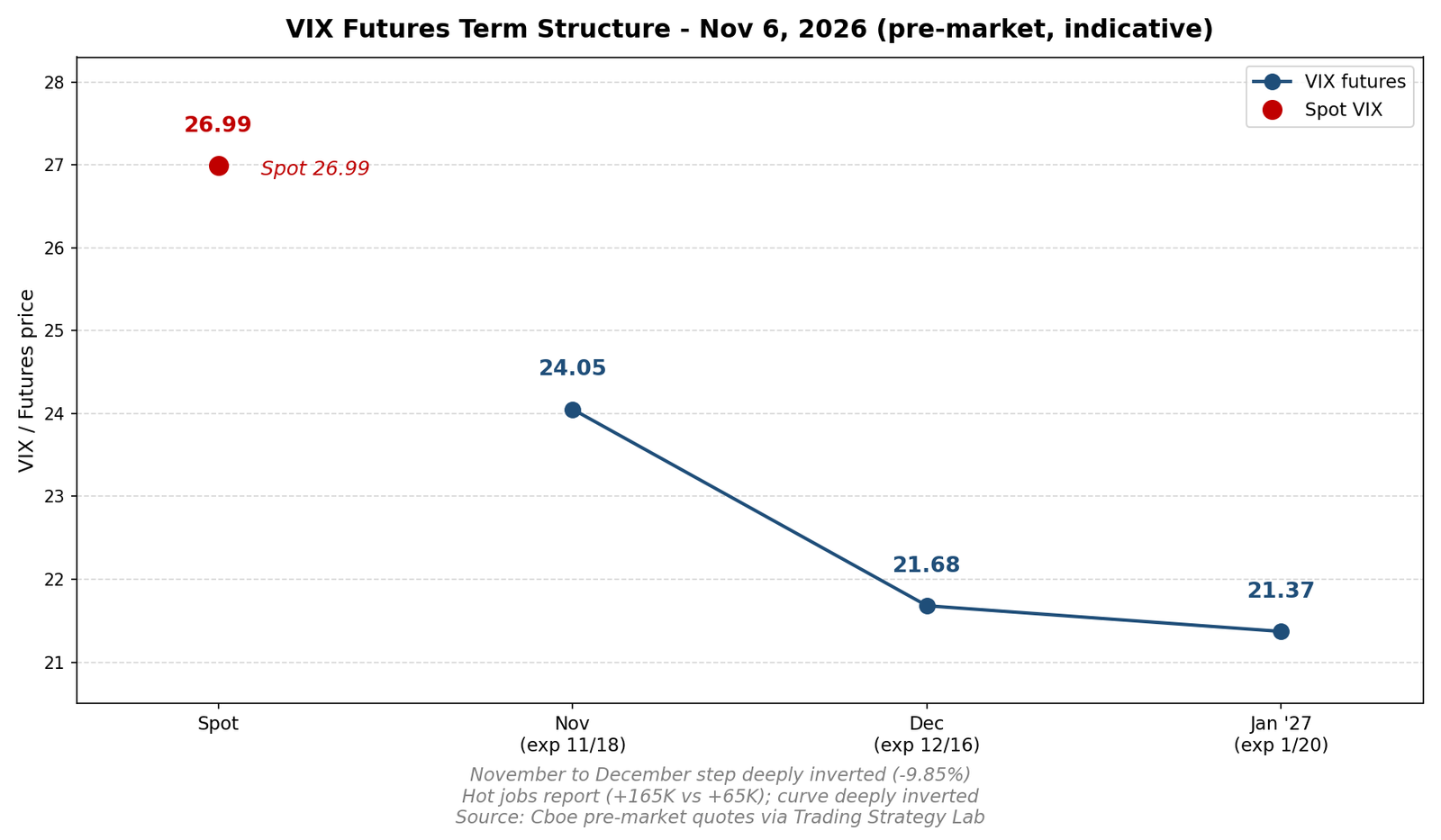
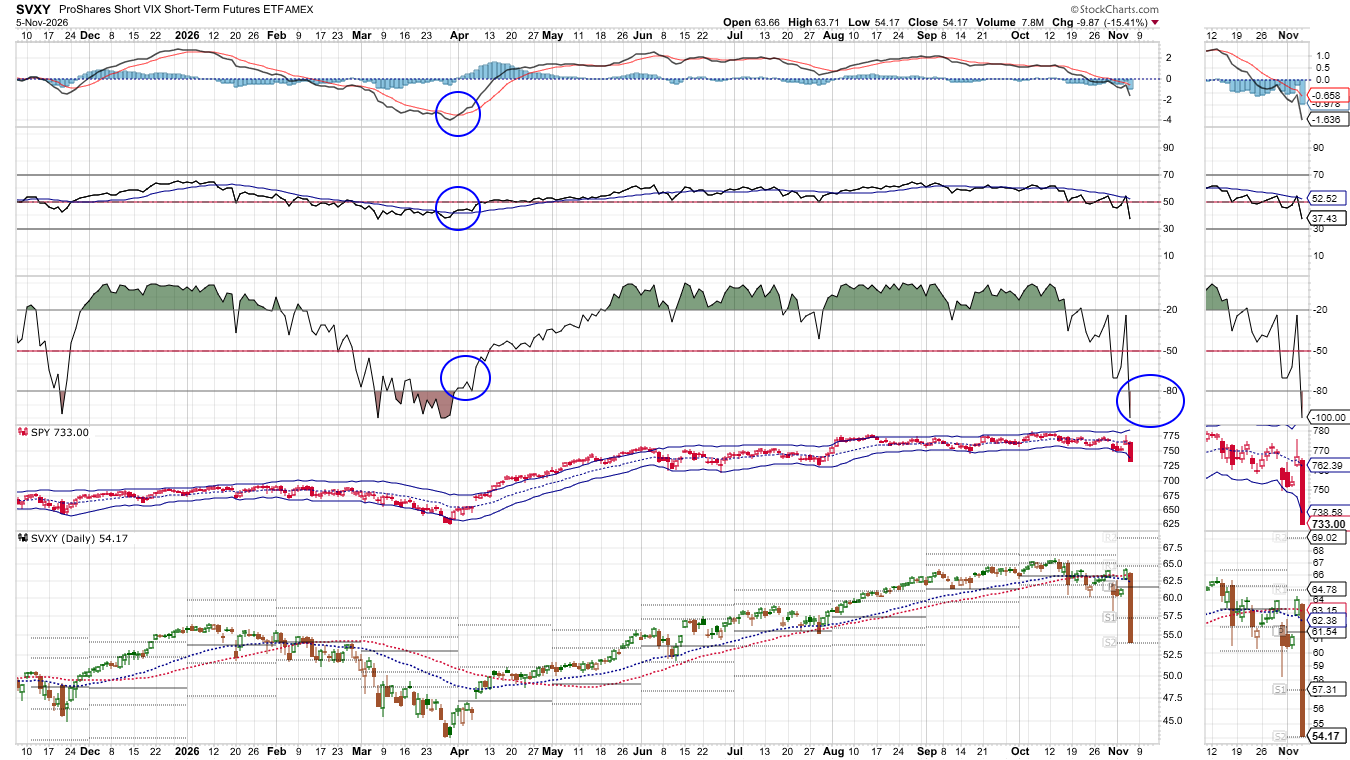
This morning spot volatility sits at 26.99, down from Thursday’s close of 28.18, but the shape of the curve is the problem. The November contract sits at 24.05 and the December contract at 21.68, so the December contract sits 2.37 points below the November contract, a downward step of 9.85 percent. That is the most deeply inverted November to December step in this log’s history, far below the long term median step of about 6.3 percent. The January contract sits at 21.37, so the curve slopes down from spot all the way through January. Spot volatility sits 2.94 points above the November contract, so there is no cushion underneath at all. In plain terms, the market is paying for near term stress and pricing calmer volatility further out, and an inverted curve is itself the stress signal, not a buying opportunity.
Positioning gives the same warning in plain terms. Dealer hedging ended Thursday in short gamma territory, which means hedging tends to amplify moves in either direction rather than damp them. One snapshot puts the flip level near 7,653, with a call wall near 8,100 and a put wall near 7,500, and spot closed at 7,353.73, about 299 points below the flip. A second snapshot puts the call wall near 7,700 and the put wall near 7,000, with the flip unresolved. The methods disagree on where the walls sit, but both agree dealers are positioned to chase moves, not calm them. The expected daily move for the S&P 500 is about plus or minus 1.70 percent.
The October jobs report blew past expectations, and the market’s answer is a split tape. Payrolls rose 165,000 against about 65,000 expected, unemployment came in at 4.1 percent against 4.2 percent expected, and average hourly earnings rose 0.4 percent on the month and 3.1 percent on the year, against 0.3 percent and 2.9 percent expected. August was revised up 53,000 to 186,000 and September up 31,000 to 60,000, a combined 84,000 of upward revisions. Hiring rebounded hard after two soft prints. The bounce this morning is narrow and rotational: Nasdaq 100 futures are up about 1.56 percent as chip names lead a premarket rebound, S&P 500 futures are up about 0.20 percent, and Dow futures are down about 0.93 percent. A Nasdaq led bounce with the Dow down is short covering and rotation, not a broad all clear. The 10 year Treasury yield sits at about 4.87 percent, up from 4.84 percent at Thursday’s close, and the dollar is firmer near 102.0. Gold is about 4,057 dollars, down about 1.38 percent, and West Texas crude is about 91.12 dollars, up about 0.66 percent.
The December question is now sharper. A hot print keeps a December hike as the base case, with market pricing putting it at about 72 percent, and it takes the growth scare tail off the table but replaces it with a higher for longer tail. For a December hike to be taken off the table, inflation needs to keep cooling, and the next tests are Tuesday’s October CPI and the November 25 PCE report. The Fed target range was held at 3.75 to 4.00 percent on October 28 on a 10 to 2 vote, and the next meeting is December 8 to 9. Fed speakers today include St. Louis Fed President Musalem at 9:10 AM, Governor Bowman at 12:15 PM, and San Francisco Fed President Daly at 1:00 PM. The University of Michigan preliminary November sentiment print lands at 10:00 AM, with consensus at 48.0.
What is next: Tuesday brings October CPI, Friday brings PPI, Monday November 17 brings October retail sales, and Wednesday November 25 brings October PCE and the second estimate of third quarter GDP.
What changes the read: the November to December step widening back toward a healthy upward slope, with spot volatility settling and holding below 20 and real cushion rebuilding underneath it, would support a calmer read. Until the curve flips back to an upward slope, we stay RED, defensive and patient, with no hurry to buy into a tape where dealer hedging amplifies every move.
Educational market analysis only. Not investment advice. See Terms of Use.
Leave a Reply