Our regime read is unchanged: AMBER, continue defensive posture. What changed this morning is a small but real improvement in the shape of the curve. The November contract is back below the December contract, so the November to December gap is positive again for the first time in this recent run, at plus 0.53%. That is a flip in the right direction, not a return to health. A healthy gap of this kind runs closer to 6%, so a 0.53% gap still leaves the curve nearly flat where it matters most, right into the FOMC decision.
Monday’s tape closed higher. The S&P 500 finished at 7,676.77, up 0.70%, the Dow rose 0.28% to 52,361.58, and the Nasdaq gained 0.82% to 26,169.38. This morning futures are higher again, with the S&P up about 0.39%, helped by oil easing off Friday’s spike and by Monday’s AI-led rebound. West Texas crude is near $100.90, down from Monday’s $101.76 settlement, and Brent is near $116, after Monday’s $115.81 settlement. The geopolitical premium is easing on Saudi-Iran de-escalation talks, not gone.
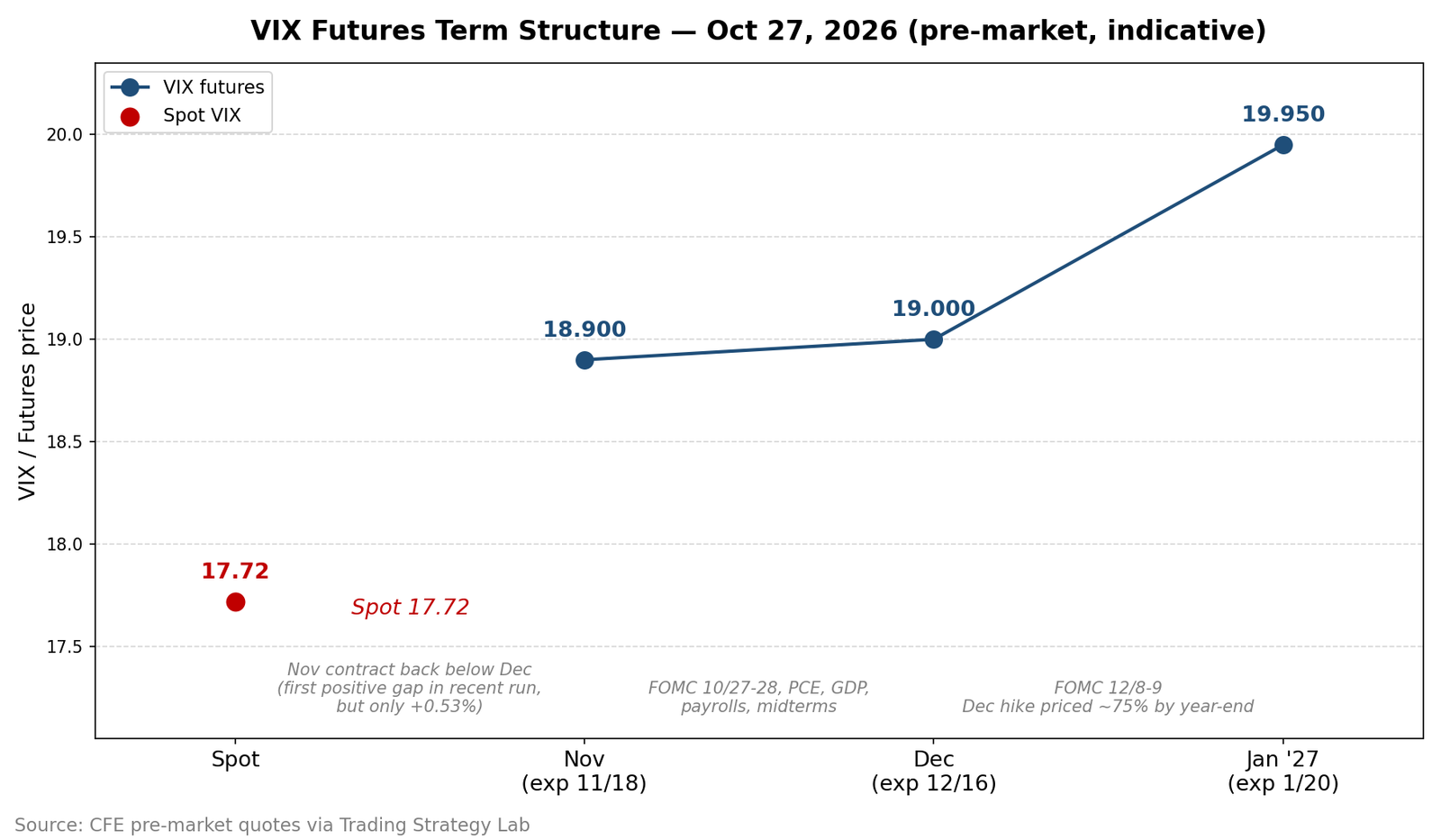
Spot VIX sits at 17.72 this morning, down from Monday’s 18.39 close. The November contract sits at 18.90 and December at 19.00, so the market is still paying almost the same price for November volatility as for December. That is what a nearly flat pair means: traders are still paying up for the event cluster inside the November window, the October 27 to 28 FOMC meeting, the September PCE report and Q3 GDP on Thursday morning, the November 3 midterms, November 6 payrolls, and October CPI on November 10, and discounting everything behind it. The November to December gap of plus 0.53% sits at the low end of the ten-year distribution, so the curve is still far from a healthy slope. There is a little more cushion than yesterday: spot sits 1.18 points under the November contract, up from just 0.07 points on Monday morning, because spot fell faster than the November contract. But the total slope across the next three months is only 2.23 points, with the November to December pair contributing just 0.10 points of it. Selling volatility right now still earns very little while event risk is at its peak.
Positioning confirms the fragility. Dealers are in negative gamma, meaning their hedging amplifies moves instead of damping them, and spot at 7,677 sits below the 7,775 flip level where that amplification kicks in. The 7,650 put wall is just under spot, so it is today’s line in the sand; a break under it in negative gamma can accelerate the move. Overhead, 7,775, the flip, and 7,800, the call wall, are the levels to watch. Put hedging stays heavy, with put volume running about 1.24 to one over calls. The expected daily move is about plus or minus 1.12%, roughly 86 S&P points.
This morning’s durable goods report was a mild beat that the tape is treating as confirmation, not a trigger. September orders rose 1.8%, against a consensus around 1.5 to 1.7%, but orders excluding transportation rose only 0.5%, just under consensus, so the headline was flattered by aircraft while the core print was a touch soft. Orders are up in six of the last seven months, which keeps the growth story intact without adding to December hike pressure. The 10-year Treasury yield sits near 4.97 to 4.98%, just under the round 5% level that has acted as a warning line all month. The Fed is in its blackout period through October 29, so data trades the tape until the decision Wednesday at 2:00 PM. A Wednesday hold is priced around 90%, while roughly 75% expect at least one hike by year-end. For a December hike to be taken off the table, inflation needs to keep cooling, and Brent above $115 makes that job harder. Today’s remaining data, consumer confidence and new home sales at 10:00 AM, are second-tier prints; the week is decided Wednesday and Thursday.
One caution from Monday’s rally: breadth was narrow. The median S&P 500 stock rose just 0.21% against the index’s 0.70%, as chips and AI names led. That is a relief rally led by a few names, not broad buying, and it is one more reason not to chase exposure into the FOMC.
What changes the read: the November to December gap widening materially toward a healthy slope, or spot VIX settling and holding lower with real cushion rebuilding underneath it. Until one of those happens, we stay defensive: no new short-volatility harvesting into Wednesday and Thursday, strict stops on existing credit spreads, and no hurry into the FOMC.
Educational market analysis only. Not investment advice. See Terms of Use.
Leave a Reply