October 30, 2026
Our regime read is unchanged: AMBER, continue defensive posture. What changed overnight is the reason for that read. This morning belongs to earnings, not to the data. Amazon and Intel revived the question of how much big tech is spending on artificial intelligence, Nasdaq futures are down more than 2 percent, and the shape of the volatility curve has now inverted at its nearest step.
Thursday’s tape closed lower. The S&P 500 finished at 7,720.39, down 0.30 percent, the Nasdaq fell 1.38 percent, and the Dow fell 0.25 percent. This morning the split is sharp: S&P 500 futures point down about 1.00 to 1.06 percent, Nasdaq 100 futures point down about 2.19 to 2.34 percent, and Dow futures are about flat, up 0.03 to 0.05 percent in early readings. That split reflects the Dow’s lower weight in mega-cap tech, not a broad market that is holding up evenly.
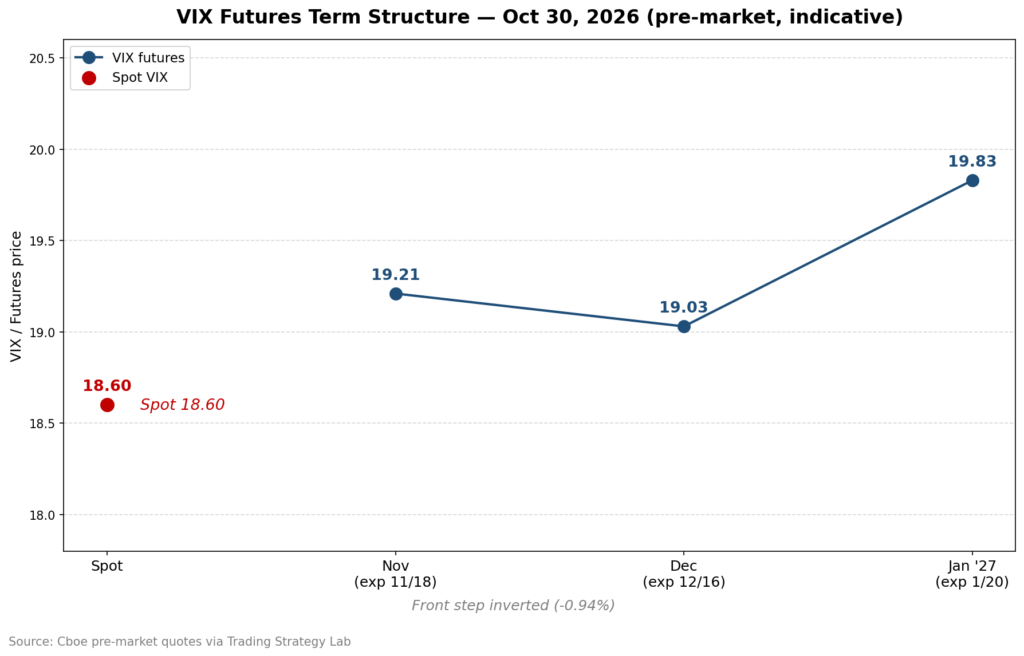
Spot VIX sits at 18.60 this morning, up 1.40 points from Thursday’s close of 17.20. The November contract sits at 19.21 and the December contract at 19.03, so the market is now paying more for November volatility than for December. That gap of minus 0.18 points, or minus 0.94 percent, is a sharp turn from Thursday’s already flat plus 0.27 percent, and it sits far below the long term median gap of about 6.3 percent. In plain terms, traders are paying up for the event cluster inside the November window, the November 3 midterms, the November 6 payrolls report, and October CPI on November 10, and pricing the December step below it. There is only a thin cushion underneath: spot sits 0.61 points under the November contract. The total slope from spot to January, at 19.83, is only 1.23 points, down from 2.60 points on Thursday. Selling volatility right now still earns very little while event risk is at its peak, because almost no price decline is built into that first step, and even the longer slope is thin.
The December question will not go away. December hike odds were cited at about 75 percent on Friday morning, down slightly from 84.2 percent the previous day, which still prices a hike as the base case, not as a coin flip. For a December hike to be taken off the table, inflation needs to keep cooling, and the next tests are the November 10 CPI report and the November 25 PCE report. The Fed backdrop fits that read. The target range was held at 3.75 to 4.00 percent on October 28 on a 10 to 2 vote, with Governors Cook and Hammack dissenting in favor of an immediate hike. The next meeting is December 8 to 9. The main soft counterweight remains September payrolls, which printed just 29,000 jobs, against strong third quarter GDP of 3.4 percent annualized and sticky September PCE, with core PCE at 3.1 percent on the year, up from 3.0 percent in August.
Earnings are doing the rest of the morning’s work. Amazon reported third quarter net sales of $201.9 billion, with AWS revenue up 39 percent to $46 billion, but trailing 12 month free cash flow swung to a $42.4 billion outflow and the company kept its 2026 capital spending plan near $220 billion. Amazon shares are down about 7 percent premarket. Intel rose 21 percent in third quarter revenue to $13.7 billion and beat on adjusted earnings per share, but guided fourth quarter revenue to $15 billion to $16 billion and adjusted earnings per share to $0.25, below expectations, citing weak PC demand, manufacturing constraints, and a two week shutdown at its Kiryat Gat fab that cut the fourth quarter outlook by about $300 million. Intel shares are down about 25 percent premarket. Alphabet fell more than 12 percent on Thursday, its worst day in over 20 years by one account, after its own miss.
Two other pressures are worth watching. The 10 year Treasury yield sits near 4.90 to 4.93 percent, down from Thursday’s close near 4.98 percent and back below the round 5 percent level after a flight to safety on AI spending worries, with the 2 year not separately quoted this morning in the briefing. Oil is firmer, with West Texas crude near $103.52 to $104.13, up about 1.5 percent on Houthi attacks on Saudi Arabia raising supply disruption worries, gold is near $4,030 to $4,033, the dollar index is near 101.70 to 101.77, and the briefing carried no fresh Bitcoin quote this morning.
Positioning gives a mixed read today, so we are not leaning on it hard. One snapshot puts dealers in a position where their hedging amplifies moves, with a flip level near 7,728, a put wall near 7,000, and a call wall near 8,000. A separate model puts the flip near 7,694, with a put wall near 7,720 and a call wall near 7,725, and net gamma near zero. When two methods disagree this plainly, the plain read is to treat the positioning as unsettled, not settled. For today’s expiry, max pain sits near 7,720, with a call wall near 7,800 and a put wall near 7,700. The expected daily move is about plus or minus 1.17 percent.
What is next: Chicago PMI for October at 9:45 AM, consensus 56.0 against 58.8 prior, with one independent forecast at 50.0, so treat the consensus with care. No Fed speakers are scheduled today in the sources checked. Next week’s tests are the November 6 jobs report and the November 10 CPI report.
What changes the read: the November to December gap widening materially toward a healthy slope, or spot VIX settling and holding lower with real cushion rebuilding underneath it. Until one of those happens, we stay defensive: no new short volatility harvesting into a tech-led gap down and the 9:45 AM Chicago PMI print, strict stops on existing credit spreads, and no hurry into the December meeting.
Educational market analysis only. Not investment advice. See Terms of Use.
Leave a Reply