November 2, 2026
Our regime read is unchanged: AMBER, continue defensive posture. Futures are steadying after Friday’s tech-led sell-off, helped mainly by a sharp fall in oil, but the shape of the volatility curve has not healed. The November to December step is still inverted, so near-term event risk is still priced above the next step.
Friday’s tape closed lower. The S&P 500 finished at 7,580.07, down 1.82 percent, the Nasdaq Composite fell 2.86 percent to 25,437.00, and the Dow fell 1.09 percent to 51,770.31. This morning the bounce is modest: S&P 500 futures are about 7,638 to 7,654, up roughly 0.3 to 0.5 percent, Nasdaq 100 futures are up roughly 0.6 to 0.8 percent, and Dow futures are up roughly 0.4 to 0.6 percent in early readings. That is a steadying, not a reversal, after a Friday fall led by mega-cap tech and chips.
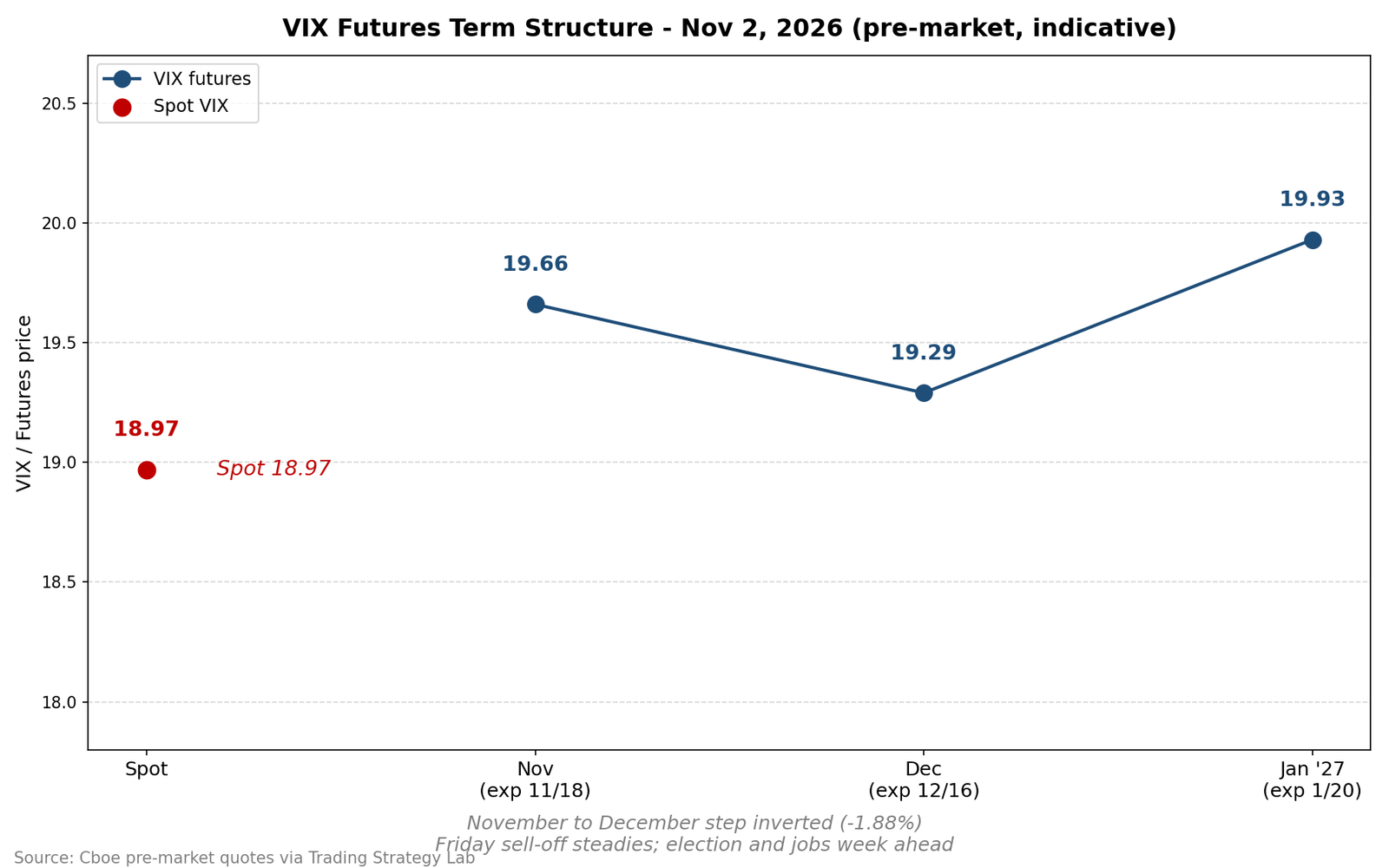
Spot VIX sits at 18.97 this morning at 8:40 AM ET, down from Friday’s close of 19.42. The November contract sits at 19.66 and the December contract at 19.29, so the market is still paying more for November volatility than for December. That gap of minus 0.37 points, or minus 1.88 percent, is less deeply inverted than Friday’s close reading of minus 2.73 percent, but it sits far below the long term median gap of about 6.3 percent. In plain terms, traders are paying up for the event cluster inside the November window, the November 3 midterms, the November 6 payrolls report, the November 10 CPI report, and the November 18 FOMC minutes, and pricing the December step below it. There is only a thin cushion underneath: spot sits 0.69 points under the November contract. The total slope from spot to January, at 19.93, is only 0.96 points. The curve has eased, but it is still almost flat overall to January.
The December question will not go away. December hike odds were cited this morning at about 72 to 73 percent, down from about 82.6 percent right after the October decision, which still prices a hike as the base case, not as a coin flip. For a December hike to be taken off the table, inflation needs to keep cooling, and the next tests are Friday’s payrolls report and the November 10 CPI report. The Fed backdrop fits that read. The target range was held at 3.75 to 4.00 percent on October 28 on a 10 to 2 vote, with Governor Cook and Cleveland Fed President Hammack dissenting in favor of an immediate hike. The next meeting is December 8 to 9.
Market news this morning, with no position framing, is a bounce in the names that fell hardest on Friday. Intel inched about 0.2 percent higher in premarket after Friday’s 28.58 percent fall, while Apple eased about 0.4 percent ahead of its report after today’s close and Palantir rose more than 1 percent. Chips bounced with the SOXX up about 1.58 percent premarket after falling 8.24 percent Friday, and Okta rose on joining the S&P 500 on November 4, replacing Kenvue. Overnight in Asia, South Korea’s KOSPI rose 2.24 percent, the Nikkei fell 0.33 percent, and the Hang Seng rose 0.42 percent.
Two other pressures are worth watching. The 10 year Treasury yield sits about 4.91 to 4.93 percent this morning, easing from Friday’s close near 4.93 percent and still below the 5 percent round number. Oil is doing most of the calming this morning, on US-Iran diplomacy hopes: West Texas crude is below 100 dollars, about 99.25 to 99.80 dollars, down roughly 4 percent after Friday’s close of 104.12 dollars, and Brent crude is about 108.40 to 109.00 dollars for the January contract, down roughly 4 percent. Gold is about 3,911 to 3,915 dollars, up roughly 0.4 to 0.9 percent, and the dollar index is about 101.62, down about 0.26 percent.
Positioning gives a mixed read today, so we are not leaning on it hard. One morning snapshot puts spot at 7,580.07 below a flip level near 7,777 and below a put wall near 7,600, a setup in which dealer hedging can amplify moves. A Friday close snapshot puts the flip near 7,673, with a put wall near 7,000 and a call wall near 8,000. When two methods disagree this plainly, the plain read is to treat the positioning as unsettled, not settled. For today’s expiry, max pain sits near 7,635, with a call wall near 7,600 and a put wall near 7,600. The expected daily move is about plus or minus 1.20 percent.
What is next: there is no 8:30 AM release today, so there is no early print to react to this morning. The first US data arrive at 9:45 AM with the S&P Global manufacturing PMI for October, prior 56.0, followed at 10:00 AM by the ISM manufacturing PMI for October, consensus 54.5 to 54.7 against a prior 54.5, with prices paid the inflation flag inside that report, and construction spending for September, consensus up 0.5 percent. Chicago Fed President Austan Goolsbee moderates a discussion at 11:15 AM, and the Federal Reserve Senior Loan Officer Opinion Survey arrives at 2:00 PM. The week ahead is the reason for caution: Tuesday brings the midterm elections and JOLTS job openings, Wednesday brings ADP employment and ISM services, and Friday brings the October employment report, with payrolls consensus about 50,000 to 65,000 against a prior 29,000 and unemployment at 4.2 percent. Apple and Palantir report after today’s close.
What changes the read: the November to December gap widening materially toward a healthy slope, or spot VIX settling and holding lower with real cushion rebuilding underneath it. Until one of those happens, we stay defensive and patient, with no hurry to add risk into an election, a jobs report, and an Apple report.
Educational market analysis only. Not investment advice. See Terms of Use.
Leave a Reply