Our regime read is unchanged: AMBER, continue defensive posture. What changed since Friday is the degree, not the direction. The November contract still sits above the December contract, so the curve is still inverted at the front, but the gap narrowed sharply, from negative 1.27% on Friday to negative 0.26% this morning. The market is still paying up for this week’s event cluster, just not as frantically as it was.
Friday’s tape closed soft. The S&P 500 finished at 7,623.68, down 0.52%, the Dow fell 1.23% to 52,215.16, and the Nasdaq slipped 0.21% to 25,955.34. This morning futures are higher across the board, with the S&P up about 0.3%, helped by oil pulling back from Friday’s spike. West Texas crude is near $101 to $102, down from Friday’s $103.27 settlement, and Brent is near $115, down from $116.72. The pullback eases the supply risk premium from the weekend’s attacks on Saudi facilities, but it does not erase it.
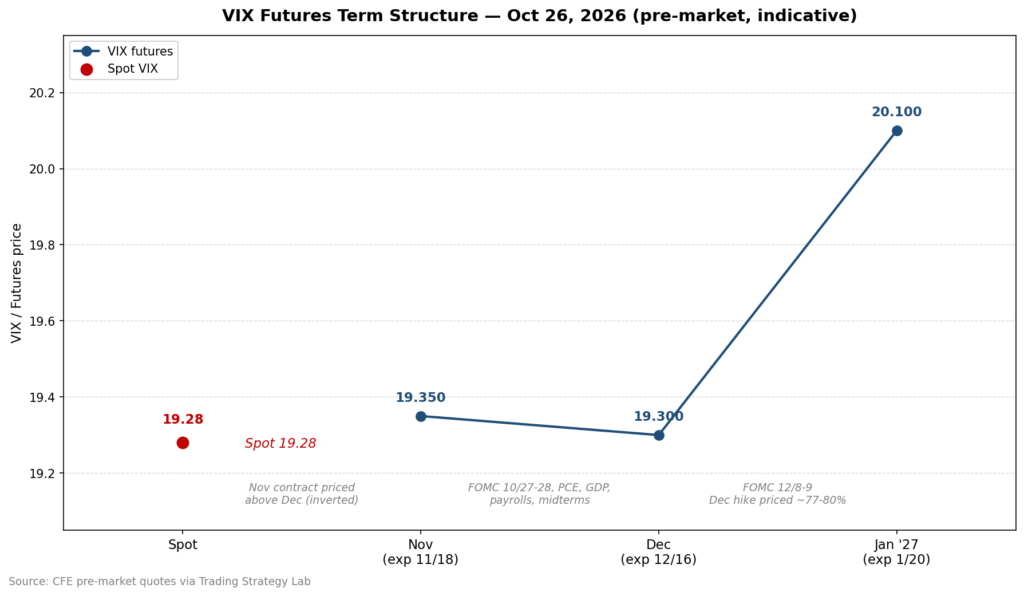
Spot VIX sits at 19.28 this morning, down from Friday’s 19.45 close. The November contract sits at 19.35 and December at 19.30, so the market is still paying more for November volatility than December. That is what an inverted pair means: traders are paying up for the event cluster inside the November window, the October 27 to 28 FOMC meeting, the September PCE report and Q3 GDP on Thursday morning, the November 3 midterms, November 6 payrolls, and October CPI on November 10, and discounting everything behind it. The November to December spread of negative 0.26% sits in the bottom few percent of the ten-year distribution, so the curve is still far from a healthy slope. There is almost no cushion anywhere: spot sits just 0.07 points under the November contract, and the total slope across the next three months is only 0.82 points, with the front pair subtracting rather than adding. Selling volatility right now earns essentially nothing while event risk is at its peak.
Positioning confirms the fragility. Dealers are in negative gamma, meaning their hedging amplifies moves instead of damping them, and spot at 7,624 sits below the 7,737 flip level where that amplification kicks in. The 7,625 put wall is essentially at spot, so it is today’s line in the sand; a break under it in negative gamma can accelerate the move. Overhead, 7,730, the max pain level for today’s expiry, and the 7,737 flip are the levels to watch. Put hedging stays heavy, with put open interest running about 2.4 to one over calls. The expected daily move is about plus or minus 1.21%, roughly 93 S&P points.
This morning’s Chicago Fed activity index came in at +0.07 for September, above the negative 0.10 consensus, with August revised to negative 0.08 and the three-month average at +0.03. That is a small beat that leaves growth hovering near trend, not a recession signal, and it does not change the December hike math with PCE due Thursday. The 10-year Treasury yield sits near 5.01%, right on the round 5% level that has acted as a warning line all month. The Fed is in its blackout period through October 29, so data trades the tape until Chair Warsh speaks Wednesday afternoon. An October hold is the strong consensus at about 90%, while a December hike is priced around 77 to 80%. For a December hike to be taken off the table, inflation needs to keep cooling, and Brent above $115 makes that job harder. Today’s remaining data is the Dallas Fed manufacturing survey at 10:30, a second-tier print; the week is decided Wednesday and Thursday.
One more wrinkle from the weekend: shares of the neocloud names CoreWeave and Nebius fell about 3% premarket after a Sunday post questioning AI data center financing. It is a reminder that the AI trade’s problem this month is financing and monetization, not demand alone, and it is one more reason not to chase exposure into the FOMC.
What changes the read: the November contract cheapening back below December so the curve rebuilds real slope, or spot VIX settling and holding below 19 with the cushion to November rebuilding. Until one of those happens, we stay defensive: no new short-volatility harvesting into Wednesday and Thursday, strict stops on existing credit spreads, and no hurry into the FOMC.
Educational market analysis only. Not investment advice. See Terms of Use.
Leave a Reply