Thursday was a rotation, not a broad washout, but the curve underneath it just flipped. The November VIX contract is now priced above the December contract, an inversion that prices the near-term event cluster above everything behind it. Our regime read stays AMBER, continue defensive posture.
Thursday’s tape split in two. The S&P 500 fell 1.21% to 7,663.43, its worst day since late July, and closed below its 50-day moving average near 7,703. The Nasdaq dropped 2.60%, its worst since June, with semiconductors down 6.7%. But the Dow finished flat at 52,867.98 and the equal-weight S&P rose 0.73%, with 6 of 11 sectors higher. The wound is the AI-capex trade: Meta fell 6.98% after guiding to $135 to $145 billion a year in capital spending, and Western Digital and Bloom Energy sold off even after beating estimates. This morning futures are mixed and soft, with the S&P down about 0.2 to 0.3%.
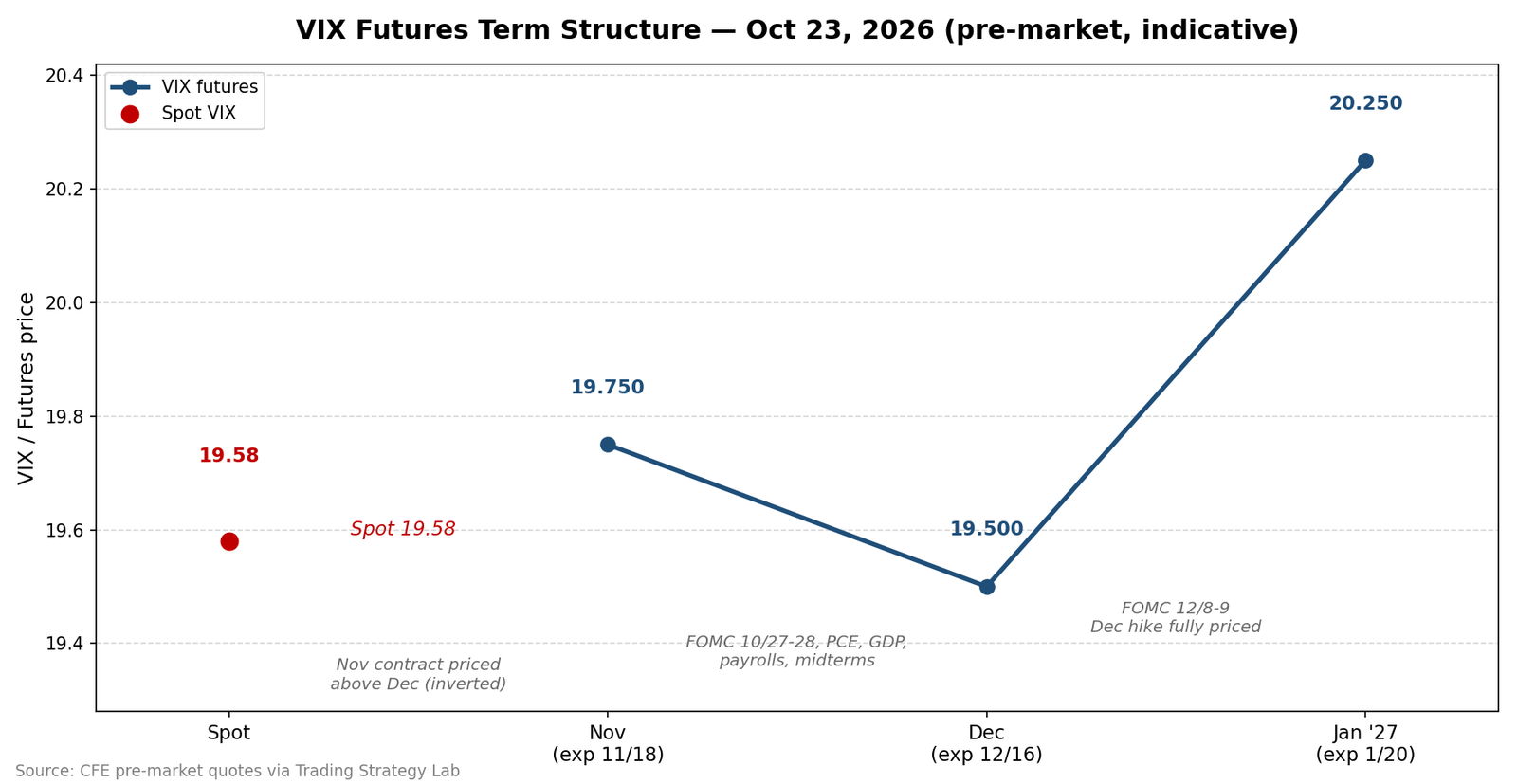
Spot VIX sits near 19.58 this morning, up about 3% from Thursday’s 19.03 close, and the curve is pricing the gauntlet directly. The November contract sits at 19.75 while December sits at 19.50, so the market is paying more for November volatility than December. That is what an inverted pair means: traders are paying up for the front event cluster, the October 27 to 28 FOMC, the September PCE and Q3 GDP reports on October 29, the midterms, payrolls and October CPI, and discounting everything behind it. The November-to-December spread is negative 1.27%, the second-lowest reading in our running log and in the bottom one to two percent of the ten-year distribution. There is almost no cushion anywhere: spot sits just 0.17 points under the November contract, and the total harvestable roll across the next three months is only 0.67 points, with the front pair subtracting rather than adding. Selling volatility right now earns essentially nothing while event risk is at its seasonal peak.
Positioning confirms the fragility. Dealers are in negative gamma, meaning their hedging amplifies moves instead of damping them, and spot at 7,663 sits just below the 7,746 flip level where that amplification kicks in. The 7,650 put wall directly underneath is today’s line in the sand; a break under it can accelerate the move. Overhead, 7,700 to 7,710, today’s call wall and max pain level, is the pin. Put hedging is heavy, with put open interest running about three to one over calls.
The Fed is in its blackout period through October 29, so data trades the tape until Chair Warsh speaks Wednesday afternoon. A December hike is fully priced by futures markets. The 10-year held just under 5% after Thursday’s biggest one-day drop since March 2023, a flight-to-safety bid on the rotation. Brent crude at about $114, a five-month high on fresh Houthi attacks on Saudi energy infrastructure, pushes the other way. For a December hike to be taken off the table, inflation needs to keep cooling, and $114 Brent makes that job harder. Today’s flash PMI at 9:45 and the final Michigan sentiment reading at 10:00 are the last data before the FOMC week.
Watchlist note: Carpenter Technology (CRS) reported before the open Thursday. Record first-quarter operating income of $196.4 million, up 28% year over year, and EPS of $3.25 beat the $3.04 consensus, but sales of $798.2 million missed the $830.8 million estimate and free cash flow was negative $24.8 million. The stock fell 20.62% to $292.26. It remains above our $273.13 ratio basis and the $250 Bear case, but the flush deserves a look before the FOMC week.
What changes the read: the November contract cheapening back below December so the curve rebuilds real slope, or spot VIX settling and holding below 19 with the spot-to-November cushion rebuilding. Until one of those happens, we stay defensive: no new short-volatility harvesting into the event cluster, strict stops on existing credit spreads, and no hurry into next week’s FOMC.
Educational market analysis only. Not investment advice. See Terms of Use.
Leave a Reply